A look at the new realities of boardgame distribution: the game company Days of Wonder sells more than 75% of the copies of "Ticket to Ride" as an iPad app compared to its classic boxed set. It makes one wonder if traditional game companies shouldn't just all be reclassified as makers of videogames.
And, it changes the equation of indie game designers. Why indulge in the effort to make intricate sets with lots of pieces when one can far more readily distribute an app of your game. Naturally, that's what I faced with Pirate Ring, which kicked around for a few years in prototype version before Patrick and I set out to make it an iOS game.
I love the feel of a real game, but the economies of distribution and retail/online sales are daunting. Which makes this an exciting time to look at the rising possibilities of abstract strategy games, which hold a special place for me as a gamer. And I've been quite interested in a new game just released for iOS called Catchup.
This is a very intriguing simple game with some deep strategy. It's only $2.99 on the AppStore, definitely worth a look. I've followed the game's designer Nick on his blog (see my sidebar) and the app is a real achievement and a bellweather for what I hope is an ever-growing interest in abstracts altogether.
I really like the elegance of the approach on Catchup. Just tap to place your pieces and to pool your claimed territory together, while navigating the subtle mechanism of having less pieces to place if you move ahead of your opponent. I like the speed of play and the casual ease of it, and I'm a fan of the slow-scaling A.I. that grows slowly harder and harder. Cheers from the Pirate Ringdom to this well-designed game, a notable addition to the world of abstracts.
And, with last week's release of the iPhone 6 and the 6-Plus (MUCH bigger screens) I'm very curious to see what this does for the smartphone as an even more potent platform for games. There's potential for even more good stuff to follow, much the way the iPad brought such a revolution in touch-boardgaming.
Monday, September 29, 2014
Thursday, June 5, 2014
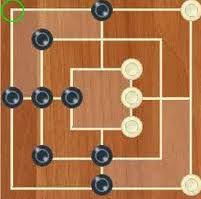
Nine Man Morris/ Mühle
One of the biggest influences on Pirate Ring has been Nine Man Morris. I was introduced to it under its German name Mühle when I visited the North Sea region of Germany at the age of sixteen. Alex Schmitz-Neuber challenged me to a match and I was instantly hooked by its fast gameplay and the dynamics of its compact board. How did three concentric squares pack in so much strategy?
Mühle, or Mills, or Merels, or any one of its many names, derives from a game that was played in Egypt three thousand years ago. It's likely a testament to a game needing to conform to existing constraints. In this case, think of ancient Egyptians working for a pharaoh. Let's say they were granted a short reprieve from hard labor, what could they do? In a modern context, I see them all dropping those thick ropes hauling 3-ton quarrystones and checking their mobile devices.
But seriously, the equivalent for an ancient people with very little leisure time might have been to draw three squares in the banks of the Nile. One opponent picks up nine dark stones off the ground and the other picks out nine lighter stones. In just a minute, they can be playing a game.
I marvel at the ease with with Mills can be played. You can imagine just about any environment on Earth supporting the basic requirements for a match-up. If you can scratch that pattern in the ground and gather some loose objects from the immediate surroundings then you can play. And remnants in Egypt show that it existed in much more durable forms, etched in clay and stone. It was one of the first casual games-- key to its success was its fastplay. Before the foreman cracked the whip for everyone to return to work, someone had already prevailed as the winner.
But just as important to the fun of Mühle is its endgame format. When one player gets down to three stones, he now may move a piece anywhere instead of just adjacent points. Suddenly the presumed loser is allowed to "level up"; it's nearly a boss-battle for the leading player. The great dynamic of suddenly setting the playing field more even (a final challenge!) makes for an often-thrilling finish.
And I sometimes wonder how the playtesting went. I imagine the game designer trying to convince friends of its merits but they complain that once he takes the lead that he just slides inevitably toward his own assured victory. They pretend to enjoy the rest of the game even when they already know they will lose, so wide is his lead. Until...
Maybe this is when another player makes a suggestion: "Why don't you change the rules and let the person with three stones now move anywhere?" she says, and eureka! suddenly his game is saved from ruin. With a simple tweak, it has endured as long as the pyramids.
Nine Man Morris is a game that I've been playing on-and-off for years, and it continues to retain significant popularity, especially in Europe. Though we now enjoy far more leisure time than ancient civilizations ever could, I nonetheless like it when strategy can be served up quickly. And I have long admired Nine Man's twist-ending, a perfect adjustment that's probably kept it relevant and compelling for three millennia.
Mühle, or Mills, or Merels, or any one of its many names, derives from a game that was played in Egypt three thousand years ago. It's likely a testament to a game needing to conform to existing constraints. In this case, think of ancient Egyptians working for a pharaoh. Let's say they were granted a short reprieve from hard labor, what could they do? In a modern context, I see them all dropping those thick ropes hauling 3-ton quarrystones and checking their mobile devices.
But seriously, the equivalent for an ancient people with very little leisure time might have been to draw three squares in the banks of the Nile. One opponent picks up nine dark stones off the ground and the other picks out nine lighter stones. In just a minute, they can be playing a game.
I marvel at the ease with with Mills can be played. You can imagine just about any environment on Earth supporting the basic requirements for a match-up. If you can scratch that pattern in the ground and gather some loose objects from the immediate surroundings then you can play. And remnants in Egypt show that it existed in much more durable forms, etched in clay and stone. It was one of the first casual games-- key to its success was its fastplay. Before the foreman cracked the whip for everyone to return to work, someone had already prevailed as the winner.
But just as important to the fun of Mühle is its endgame format. When one player gets down to three stones, he now may move a piece anywhere instead of just adjacent points. Suddenly the presumed loser is allowed to "level up"; it's nearly a boss-battle for the leading player. The great dynamic of suddenly setting the playing field more even (a final challenge!) makes for an often-thrilling finish.
And I sometimes wonder how the playtesting went. I imagine the game designer trying to convince friends of its merits but they complain that once he takes the lead that he just slides inevitably toward his own assured victory. They pretend to enjoy the rest of the game even when they already know they will lose, so wide is his lead. Until...
Maybe this is when another player makes a suggestion: "Why don't you change the rules and let the person with three stones now move anywhere?" she says, and eureka! suddenly his game is saved from ruin. With a simple tweak, it has endured as long as the pyramids.
Nine Man Morris is a game that I've been playing on-and-off for years, and it continues to retain significant popularity, especially in Europe. Though we now enjoy far more leisure time than ancient civilizations ever could, I nonetheless like it when strategy can be served up quickly. And I have long admired Nine Man's twist-ending, a perfect adjustment that's probably kept it relevant and compelling for three millennia.
Wednesday, May 28, 2014
Using switchpoints
It's a simple concept, but probably the biggest strategic headscratcher that new players encounter is how to effectively use switchpoints.
To recap from the app's tutorial, switchpoints are the two marked center-points. Move the appropriate matching piece to activate a switch and then here's the dilemma... which one of your four pieces to choose?
Whichever location you tap, any piece there "switches" to the opposite type of piece, but remains the same color. If it's your piece, it always remains your piece, but switching is the most immediately powerful change you can make to the playing board; see illustration.
Some accomplished gamers I've challenged to Pirate Ring have had trouble "seeing through" to the full resulting flip of this move. It doesn't seem to be a skillset that always carries over from other games, so people sometimes have to get used to the concept of using switchpoints well.
So, here's three tips--
#1. Make rings. Easy, right? Unless you anticipate being immediately defended (by a coin--in the app). Sometimes it's worth it to wait for the right moment to switch. With some care, you can avoid some needless ring/coin standoffs.
#2. Foil your opponent from going to the Dreadnay. He really wants to, but if you switch a shared location then he can't move to the center without opening your ring for additional ships that you would earn.
#3. If you're on a 3 and you're sharing the spot with your opponent, don't be impatient about moving your ring away. That can allow an opponent to switch his piece there (to a ring scoring 3 ships) and then your ring can't even move back to cover the loss.
To recap from the app's tutorial, switchpoints are the two marked center-points. Move the appropriate matching piece to activate a switch and then here's the dilemma... which one of your four pieces to choose?
Whichever location you tap, any piece there "switches" to the opposite type of piece, but remains the same color. If it's your piece, it always remains your piece, but switching is the most immediately powerful change you can make to the playing board; see illustration.
Some accomplished gamers I've challenged to Pirate Ring have had trouble "seeing through" to the full resulting flip of this move. It doesn't seem to be a skillset that always carries over from other games, so people sometimes have to get used to the concept of using switchpoints well.
So, here's three tips--
#1. Make rings. Easy, right? Unless you anticipate being immediately defended (by a coin--in the app). Sometimes it's worth it to wait for the right moment to switch. With some care, you can avoid some needless ring/coin standoffs.
#2. Foil your opponent from going to the Dreadnay. He really wants to, but if you switch a shared location then he can't move to the center without opening your ring for additional ships that you would earn.
#3. If you're on a 3 and you're sharing the spot with your opponent, don't be impatient about moving your ring away. That can allow an opponent to switch his piece there (to a ring scoring 3 ships) and then your ring can't even move back to cover the loss.
Powers of Two 1:2:4:8:16
Pythagoras said, "All things can be expressed in numerical terms because all things can be reduced to numbers" and the history of Zelda (or Mario, etc) observes that powers of 2 (as a binary combination) have long been the framework of videogames... so, Numerologists, here's your go at Pirate Ring.
And, here in the Pirate Ringdom, we prefer the old GameCenter icon, mostly because of its classic look and the fact that it features a chess piece, godfather of turn-based strategy. Pirate Ring totally conforms to iOS7 and 8 standards, but we don't like those bubblegum bubbles of the new icon... so you'll notice in-app that we're sticking with our ol' favorite. Knight, bat, rocket, arrow-- bring it on!
• Dreadnay=1
• Switchpoints=2
• Pieces to a side=4
• Number positions=8
• Total number of ships=16
There are patterns which emerge to (maybe) intrigue you. This is a game entirely about numbers and the paths which interconnect them. As a player, you simply slide one of your rings/coins along a marked line to a new position, and there's some math-geek joy in the numeric turbulence of that choice.
If your rings surround a number then you've recruited that many ships. The abstraction of numbers is framed within a pirate's theme; and the endgame is devised as a final battle at sea. But for victory it's always about just one thing. The numbers. And of course, whose is larger...
Alright then, some Pirate riddles:
1) Most # of ships possible to recruit when you move to Dreadnay for a win?
2) Or, most # possible to recruit with your rings, period.
3) How many connecting lines on the board?
4) Including the two broken lines?
If you're unsure then you'd best play Pirate Ring (app for iPhone/iPad!)
Some answers then...
1) 8 2)10 3)16 4)18
And, here in the Pirate Ringdom, we prefer the old GameCenter icon, mostly because of its classic look and the fact that it features a chess piece, godfather of turn-based strategy. Pirate Ring totally conforms to iOS7 and 8 standards, but we don't like those bubblegum bubbles of the new icon... so you'll notice in-app that we're sticking with our ol' favorite. Knight, bat, rocket, arrow-- bring it on!
Subscribe to:
Posts (Atom)